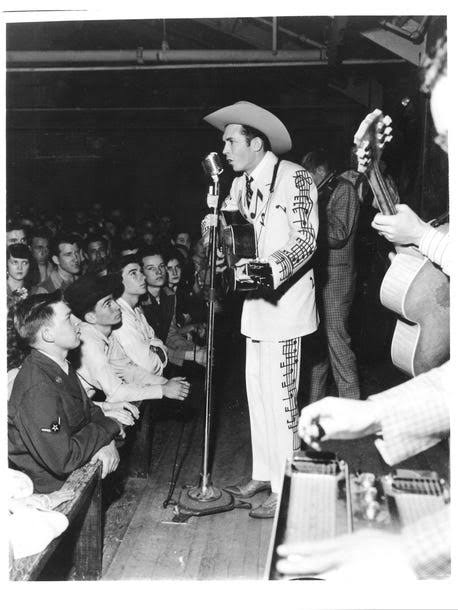
On September 17, 1923, in Mount Olive, Alabama, Hiram King “Hank” Williams was born. He would live for only 29 years, but in that short time he would become one of the most influential figures in the history of American country music. More than a century after his birth, his songs are still remembered by generations of music lovers,See More…
Hank grew up in Alabama during difficult economic times. His father, Lon Williams, was a World War I veteran who suffered from health problems, while his mother, Lillie, played an important role in raising Hank and his siblings. His childhood experiences would later influence the emotional honesty found throughout his music.
Music became an important part of Hank’s life while he was still a young boy. As a teenager, he began performing publicly and developing his own style. He eventually formed a group known as the Drifting Cowboys, beginning the musical journey that would take him far beyond Alabama.
During World War II, Hank continued performing music while also working at the Alabama Dry Dock and Shipbuilding Company in Mobile. In 1944, he married Audrey Mae Sheppard. After the war, Hank returned his attention to music and began working toward a professional recording career.
In 1946, Hank met music publisher and producer Fred Rose, who recognized his songwriting ability. Rose helped him secure a recording contract with Sterling Records, and Hank soon moved to MGM Records. His early recordings began attracting attention, and his career started moving quickly.
One of his early successes was “Move It on Over,” released in 1947. The song became a major country hit and demonstrated Hank’s ability to combine memorable melodies with simple, relatable lyrics. His distinctive voice and emotional delivery quickly separated him from many other performers of the era.
Hank’s career reached another major turning point when he became a performer on the Louisiana Hayride radio program. Radio was one of the most powerful ways for musicians to reach American audiences at the time. Hank’s performances helped introduce his music to listeners far beyond Alabama.
Then came the song that changed everything: “Lovesick Blues.” Released in 1949, Hank’s version became a massive success, spending 16 weeks at the top of the country chart. His popularity exploded, and soon afterward he was invited to perform at the Grand Ole Opry.
At the Grand Ole Opry, Hank Williams became one of the biggest stars in country music. His performances connected with audiences because his songs often sounded deeply personal. He sang about things ordinary people understood — heartbreak, loneliness, love, regret and the struggles of everyday life.
Hank also created another musical identity known as “Luke the Drifter.” Under that name, he recorded songs and spoken-word pieces that were often more reflective and moral in nature. It showed that Hank was capable of expressing different sides of his personality through music.
During the early 1950s, Hank continued producing hit after hit. Songs such as “Long Gone Lonesome Blues,” “Cold, Cold Heart,” “Hey, Good Lookin’” and “I’m So Lonesome I Could Cry” became part of the American musical landscape. His songwriting helped define what country music could sound and feel like.
His influence also reached beyond country music. Other major performers began recording his songs, bringing his writing to completely different audiences. Tony Bennett, for example, recorded “Cold, Cold Heart,” demonstrating that Hank’s songwriting could cross the boundaries between country and popular music.
But behind the success was a troubled personal life. Hank struggled with alcohol and serious health problems, and his difficulties increasingly affected his career. His story was not simply one of fame and success — it was also the story of a young man dealing with significant personal struggles.
Despite those struggles, Hank continued creating music that connected with millions of people. His greatest strength as a songwriter was his ability to make complicated emotions feel simple and honest. When he sang about loneliness or heartbreak, listeners could recognize something from their own lives in his words.
Among his most enduring songs is “Your Cheatin’ Heart,” which became one of the defining recordings associated with his name. Alongside “I’m So Lonesome I Could Cry,” “Cold, Cold Heart” and “Lovesick Blues,” it helped create a musical legacy that would survive long after his death.
On January 1, 1953, Hank Williams died at just 29 years old. His death brought an incredibly short life and career to an end. He had been a professional recording artist for only a few years, yet during that brief period he had already changed the direction of country music.
His death did not end his story. In the years that followed, Hank’s recordings continued to be played on radio stations, purchased by fans and performed by other musicians. New generations discovered his music, and his songs became part of the permanent American country music tradition.
In 1961, Hank Williams was inducted into the Country Music Hall of Fame. The honor recognized the enormous impact he had made despite having such a short career. His name became permanently associated with the foundations of modern country music.
For many Americans who grew up listening to country music on the radio, Hank Williams represents a different era — a time of jukeboxes, vinyl records, small-town dances and family radios. His songs became part of people’s memories, and for many older listeners, hearing his voice can bring back an entire chapter of American life.
Hank Williams lived only 29 years. Yet more than a century after his birth, his voice can still be heard, his songs are still recorded, and his story is still remembered. His life was short, but his music was not. Hank Williams left behind something few artists ever achieve: a legacy that continues to live long after the person himself is gone.
Leave a Reply