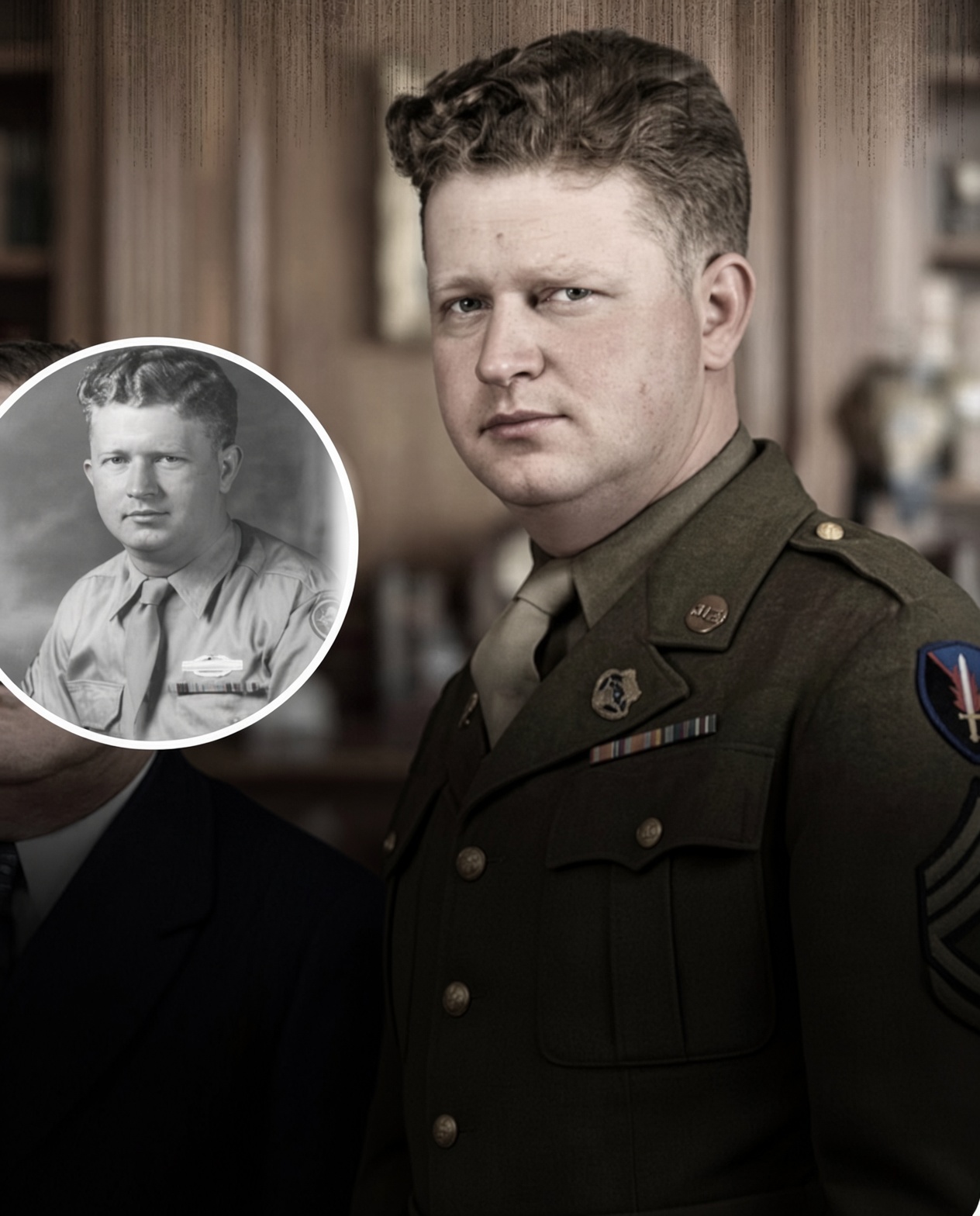
On January 27, 1945, inside a prisoner-of-war camp near Ziegenhain, Germany, an American sergeant stood face-to-face with a German commandant holding a pistol to his head. The commandant wanted one thing: a list of the Jewish-American prisoners. The sergeant was only 25 years old, but the decision he made that morning would protect more than 200 men.See More…
His name was Roderick “Roddie” Edmonds, a young soldier from South Knoxville, Tennessee. Born in 1919, Edmonds had graduated from Knoxville High School in 1938. Before the war, he had lived an ordinary American life, but everything changed when he joined the Army and was sent to Europe with the 422nd Infantry Regiment of the 106th Infantry Division.
Edmonds and his fellow soldiers arrived in Europe only days before Germany launched its massive winter offensive. The campaign became known as the Battle of the Bulge, and for the relatively inexperienced 106th Division, the fighting quickly became a nightmare. On December 19, 1944, Edmonds was captured by German forces.
By Christmas Day, Edmonds was being held at Stalag IX-B near Bad Orb. Weeks later, he and more than 1,200 other American sergeants were transferred to Stalag IX-A. Conditions were brutal, with food so scarce that prisoners reportedly had to divide a single loaf of bread among many men. Because the American officers were held separately, Edmonds became the senior American prisoner and was responsible for approximately 1,275 soldiers.
Then came the order that changed everything. The Germans announced that only Jewish-American prisoners were to report separately at the next morning’s roll call. Anyone who refused would be shot. Edmonds immediately understood the danger. More than 200 of the American prisoners were Jewish, and being identified could place their lives in grave danger.
That night, Edmonds gave his own order. Every American prisoner would report for roll call in the morning. There would be no exceptions. When dawn arrived, all 1,275 men stood together outside the barracks, refusing to allow the Germans to identify who was Jewish and who was not.
The German commandant, Major Siegmann, looked at the enormous formation and realized what Edmonds had done. He shouted that the entire group could not possibly be Jewish. Edmonds looked directly at him and answered with the words that would later become legendary: “We are all Jews here.”
Siegmann responded by drawing his pistol and pressing it against Edmonds’s head. But Edmonds refused to move. He reminded the German officer that prisoners of war were required to provide their name, rank and serial number — not their religion. He then made the consequences clear: if the Germans wanted to shoot him, they would have to shoot all of the American prisoners.
Edmonds also warned that the war would eventually end and that those responsible for crimes against prisoners could face prosecution. Germany was already losing the war, and the commandant had to consider what could happen after the fighting ended. Eventually, Siegmann lowered his weapon and walked away. The Jewish-American soldiers were not separated or handed over.
Edmonds continued protecting and organizing his fellow prisoners for roughly 100 days of captivity. He was eventually liberated and returned to Tennessee. He later served his country again during the Korean War, but remarkably, he rarely spoke about what had happened inside the German camp.
After Edmonds died in 1985, his family eventually discovered the extraordinary story. His son, Pastor Chris Edmonds, came across an article mentioning his father’s name and began investigating. He contacted former prisoners who had been with Roddie that morning, and their memories confirmed the story of the sergeant who had refused to identify the Jewish soldiers.
In 2015, Yad Vashem recognized Roddie Edmonds as Righteous Among the Nations, one of the highest honors given to non-Jews who risked their lives to save Jews during the Holocaust. Then, on March 2, 2026, more than eight decades after that roll call, Chris Edmonds accepted the Medal of Honor on his father’s behalf at the White House. Roddie Edmonds had once stood before a gun and refused to point out which men were Jewish. Instead, he stood beside all of them — and declared that they were all his responsibility.
Leave a Reply