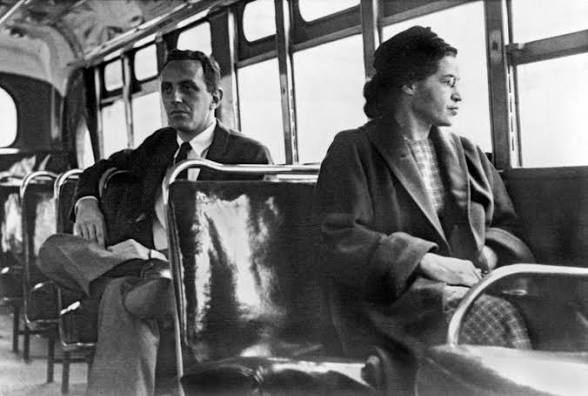
Rosa Parks was one of the most influential women in the history of the United States. She became a symbol of courage, dignity, and the fight for racial equality after refusing to give up her seat to a white passenger on a bus in Montgomery, Alabama, on December 1, 1955. Her decision helped ignite a powerful movement that changed the course of American history. But behind that historic moment was a life filled with hardship, discrimination, sacrifice, and extraordinary determination.See more…
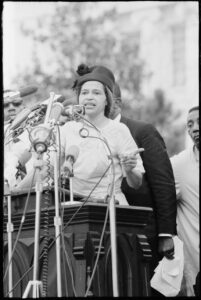
Rosa Louise McCauley was born on February 4, 1913, in Tuskegee, Alabama. She was the daughter of James McCauley and Leona Edwards McCauley. When she was young, her family moved to Pine Level, where Rosa grew up close to her mother, grandparents, and younger brother. From an early age, she experienced an America deeply divided by racial discrimination, where African Americans faced severe restrictions in their everyday lives.
Her childhood was not easy. Rosa grew up during a time when racist laws and customs throughout the American South limited the rights of African Americans. She witnessed the fear created by racial violence and learned about the threats posed by white supremacist groups, including the Ku Klux Klan. These experiences shaped her understanding of justice and strengthened her belief that nobody should be treated as less important because of the color of their skin.
Education was an important part of Rosa’s life, although opportunities for African American girls were limited. She attended the Montgomery Industrial School for Girls, an institution that emphasized education, discipline, and personal development. She later continued her studies at Alabama State Teachers College High School. However, family circumstances forced her to interrupt her education for a time. With her husband’s support, she eventually completed high school in 1933.
In 1932, Rosa married Raymond Parks, a barber who was also involved in civil rights activism. Raymond supported her education and her growing commitment to fighting racial injustice. Their marriage became an important partnership during the difficult years that followed. Although they never had children, they built a life shaped by their determination to challenge discrimination and defend the rights of African Americans.
Before she became known throughout the world, Rosa was a working woman trying to support her family. She worked as a seamstress and held other jobs to help make ends meet. But her commitment extended far beyond her professional responsibilities and home life. She believed that injustice had to be challenged and that meaningful change required people willing to take action, even when doing so involved personal risks.
In 1943, Rosa became secretary of the Montgomery chapter of the National Association for the Advancement of Colored People, known as the NAACP. In this role, she helped document cases of racial discrimination, supported efforts to register Black voters, and worked to protect people facing injustice. She was also involved in youth activities and efforts to secure equal treatment. Her later refusal to surrender her bus seat was therefore not an isolated act but part of a much longer commitment to civil rights.
One event that deeply affected Rosa was the murder of Emmett Till, a 14-year-old African American boy who was killed in Mississippi in 1955. His killers were acquitted by an all-white jury, shocking communities across the country. The injustice surrounding his death strengthened the determination of many civil rights activists, including Rosa. She understood that silence would not end a system in which people were denied their fundamental rights because of their race.
In August 1955, Rosa attended a workshop at Highlander Folk School in Tennessee, where participants discussed racial integration and strategies for social change. The experience strengthened her understanding of civil rights activism and helped prepare her for the challenges ahead. At the same time, activists in Montgomery were looking for ways to challenge the racial segregation imposed on public transportation. Rosa was already an experienced activist who understood that resisting these laws could bring serious consequences.
On December 1, 1955, after finishing a day’s work, Rosa boarded a bus in Montgomery to return home. At the time, racist regulations required Black passengers to sit in designated sections and, under certain circumstances, give up their seats to white passengers. When the driver ordered Rosa and other Black passengers to surrender their seats, she refused to move. She was 42 years old, not an elderly woman as she is sometimes mistakenly portrayed. Her decision was a deliberate challenge to a system that treated her as less worthy because of her race.
The bus driver called the police, and Rosa was arrested. She was charged under Montgomery’s segregation laws and found guilty of violating local regulations, receiving a fine of $14. However, what happened on that bus was far more than a disagreement between a passenger and a driver. Her arrest became a turning point in the civil rights movement. Photographs taken during her arrest became powerful images of the struggle, and her story soon spread far beyond Montgomery.
On December 5, 1955, the day of her trial, African American residents began the Montgomery Bus Boycott. Community leaders urged people to stop using public transportation in protest against racial segregation. What was initially planned as a one-day protest developed into a sustained movement. The Montgomery Improvement Association was established, with Martin Luther King Jr. serving as its president. Rosa supported the movement as thousands of people chose to walk, share private cars, or find other ways to travel rather than use segregated buses.
The boycott lasted 381 days, ending in December 1956. For many participants, this meant walking long distances to work despite bad weather, exhaustion, and threats. Organizers created transportation networks using private vehicles and church-owned cars so people could continue their daily lives without relying on segregated buses. Rosa supported the effort, and the determination of the community demonstrated how organized, peaceful resistance could put enormous pressure on an unjust system.
However, the success of the boycott came at a significant personal cost. Rosa lost her job at Montgomery Fair, while her husband, Raymond, also lost his job after his employer objected to discussions about the case. The couple faced financial hardship, threats, and uncertainty about their future. Although Rosa is often remembered as a quiet heroine who changed history, her life did not suddenly become easier after her arrest. Instead, her courageous decision exposed her and her family to consequences that continued for years.
As the boycott continued, the struggle also moved into the courts. On February 1, 1956, a federal lawsuit known as Browder v. Gayle was filed to challenge the constitutionality of racial segregation on Montgomery’s buses. Rosa Parks was not one of the plaintiffs in that case, as she had a separate legal proceeding. On November 13, 1956, the United States Supreme Court upheld the ruling that segregation on public transportation was unconstitutional. The decision paved the way for the boycott to end on December 20, 1956, when the ruling took effect in Montgomery.
In 1957, because of financial difficulties and continued pressure, Rosa and Raymond left Montgomery and moved to Detroit, Michigan. Many people assume that she immediately found a peaceful life after the boycott’s victory, but the reality was more complicated. In Detroit, she continued to witness discrimination, particularly in housing, education, and economic opportunities. She remained committed to equality and understood that the struggle for civil rights extended far beyond the buses of the American South.
In the years that followed, Rosa participated in important civil rights activities, including the 1963 March on Washington for Jobs and Freedom and the 1965 march from Selma to Montgomery. In 1965, she began working in the Detroit office of Congressman John Conyers, where she remained until her retirement in 1988. She helped constituents seek assistance with employment, education, housing, and other concerns. In 1987, she co-founded the Rosa and Raymond Parks Institute for Self Development to help young people develop their potential and understand the history of the struggle for freedom.
Throughout her life, Rosa received numerous honors for her contributions to American society. In 1979, the NAACP awarded her the Spingarn Medal. In 1996, President Bill Clinton presented her with the Presidential Medal of Freedom, and in 1999, she received the Congressional Gold Medal, one of the highest civilian honors in the United States. These awards recognized a lifetime dedicated to fighting for equality. Yet, for many people, her greatest achievement was not the recognition she received but her willingness to challenge injustice when doing so carried a real personal cost.
In the final years of her life, Rosa lived in Detroit and remained a respected figure in the civil rights movement. She died on October 24, 2005, at the age of 92. Her passing was marked by tributes throughout the country. On October 30, 2005, her casket was placed in honor in the Rotunda of the United States Capitol, making her the first woman to receive this distinction. The extraordinary tribute reflected the historical importance of a woman who had spent her life demanding dignity and equal treatment for all.
Today, Rosa Parks is remembered as the “Mother of the Modern-Day Civil Rights Movement,” but her story is much deeper than a single seat on a bus. She was not simply a tired passenger who accidentally became famous; she was an experienced activist who had spent years fighting discrimination. Her decision helped unite thousands of people and challenge laws that had divided American society for generations. Her legacy continues to remind the world that historic change can begin with one person who refuses to accept injustice any longer. Rosa Parks did not merely change a bus ride. She helped an entire nation confront its conscience.
Leave a Reply