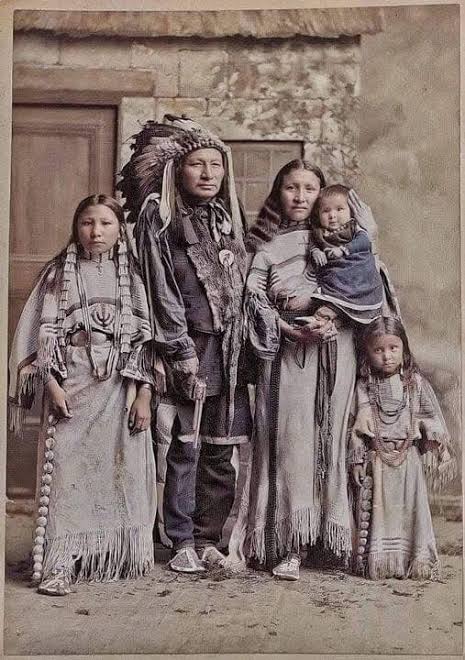
Chief Long Wolf, a Native American warrior of the Oglala Lakota people, lived a life marked by conflict, displacement, and an extraordinary journey that continued long after his death. Born around 1833 in what is now South Dakota, he grew up during a period when Indigenous communities faced increasing pressure from American expansion. His story would eventually stretch from the Great Plains of North America to a cemetery in London, England, where he remained buried for more than a century.
Long Wolf lived in a world where survival demanded courage and loyalty to his people. As American settlement expanded across Indigenous lands, the Lakota faced growing conflict over their territory, traditions, and way of life. Although detailed records of his childhood are limited, his later life reflects the hardships experienced by many Lakota people during this turbulent period. He became known as a warrior, and historical accounts described numerous scars on his body, reportedly caused by gunshot wounds and saber cuts.
One of the most famous events associated with Long Wolf was the Battle of Little Bighorn in 1876. During this historic confrontation, Lakota, Northern Cheyenne, and Arapaho warriors defeated the United States Army’s 7th Cavalry under Lieutenant Colonel George Armstrong Custer. Long Wolf is traditionally reported to have fought on the Native American side, although the details of his individual role remain uncertain. The battle became a symbol of Indigenous resistance, but it did not end the military campaigns that would ultimately force many Native communities onto reservations.
The years that followed brought enormous changes for the Lakota. As American military power increased and traditional ways of life became more difficult to maintain, Long Wolf eventually traveled with a very different kind of enterprise. He joined Buffalo Bill Cody’s Wild West Show, a traveling spectacle that presented dramatized versions of life in the American West. For Indigenous performers, joining the show could provide income and opportunities to travel during a time when their communities faced severe restrictions and displacement.
Long Wolf became one of the older and more prominent Indigenous performers in the show. He traveled across America and Europe, appearing before audiences fascinated by the romanticized image of the American frontier. The performances included horseback riding, staged battles, and demonstrations intended to recreate Western life. While crowds viewed the show as entertainment, the Native American participants carried their own histories, identities, and experiences of conflict.
Long Wolf was not simply a character in a performance; he was a man whose life had been shaped by the real struggles behind the spectacle.
In 1892, Long Wolf traveled to London with Buffalo Bill’s Wild West Show. The production attracted large audiences, bringing performers from the American West to a country thousands of miles from their homes. Long Wolf was accompanied by members of his family, including his wife, Wants, and his daughter, Lizzie. Yet this journey would become the final chapter of his life. Far from the plains where his people had lived for generations, the elderly warrior became seriously ill.
Chief Long Wolf died in London in June 1892, at approximately 59 years old. Historical accounts generally attribute his death to pneumonia, although other records mention pleurisy and complications associated with illness and previous injuries. According to family tradition, he wished to be buried in his homeland. However, bringing his body back across the Atlantic was feared to be dangerous, partly because other Indigenous travelers had died during sea voyages and had been buried at sea. His family feared that he would never receive the burial he deserved among his own people.
Buffalo Bill Cody arranged for Long Wolf to be buried at Brompton Cemetery in west London. Before his death, Long Wolf had reportedly requested that a wolf appear on his gravestone, a fitting symbol of his identity and the name by which he was remembered. His burial took place on June 13, 1892. Another member of the traveling show, a young Lakota girl named Star, who was approximately 17 months old when she died, was later buried in the same grave. Both were now resting thousands of miles from their ancestral homeland.
As the years passed, the grave gradually faded from public attention. Long Wolf’s descendants knew that their ancestor had been buried somewhere in London, but the exact location became difficult to establish. Generations passed, and the warrior who had once traveled before enormous crowds became almost forgotten in a foreign cemetery. For his family, however, the memory of his final wish endured. The story was not simply about where his body lay; it was about the importance of returning a loved one to the land and community to which he belonged.
The extraordinary search for Long Wolf’s resting place began to take shape in the early 1990s, when a British woman named Elizabeth Knight discovered his story in an old book about Native Americans. Deeply moved, she decided to investigate whether his grave could still be found. She visited Brompton Cemetery and searched for the location described in the account. After identifying the grave, she began trying to locate his living relatives in the United States. Her efforts eventually connected her with Long Wolf’s descendants, turning a forgotten historical story into a mission to bring him home.
After years of communication, research, and arrangements, the long-awaited return finally took place in September 1997. Long Wolf’s remains were exhumed from Brompton Cemetery and prepared for repatriation to South Dakota. His descendants and members of the Lakota community gathered to honor him with traditional prayers, chants, and drumming. The ceremony combined profound grief with relief: after more than 105 years abroad, the warrior was finally returning to the land of his ancestors. The remains of the young girl Star were also returned, allowing both to be laid to rest closer to their homeland.
Chief Long Wolf’s story is remembered today as more than the history of a warrior or a traveling performer. It is a story about family, cultural identity, and the determination to honor a promise across generations. His life carried him from the American plains to the stages of Europe, and his death left him separated from home for more than a century. Yet a stranger’s curiosity and his descendants’ persistence eventually brought him back. In the end, the most remarkable part of his story was not simply how far he traveled, but how his family refused to let his final wish disappear with time.
Leave a Reply