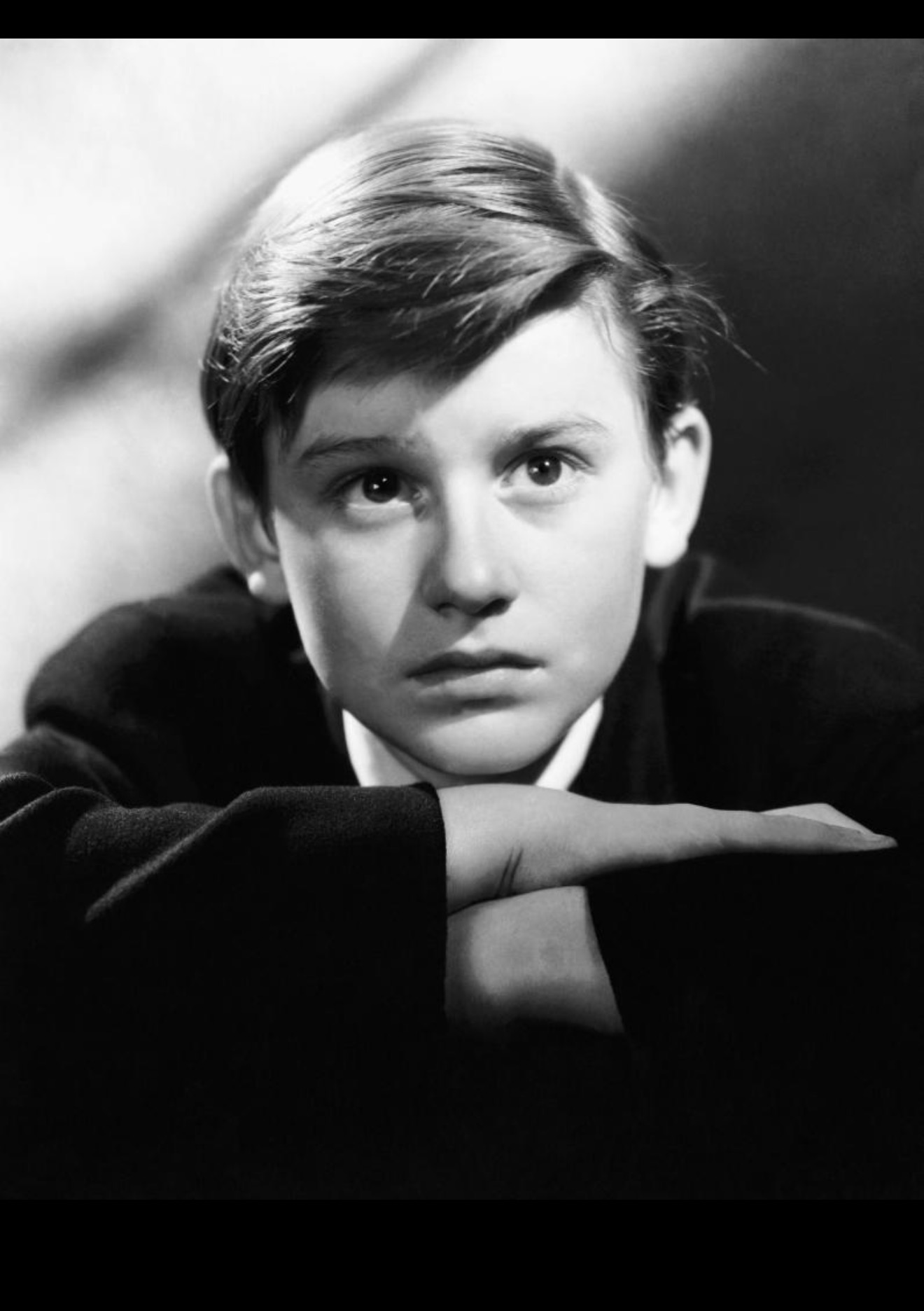
In his youth, he looked like an ordinary British boy, with a gentle face and a talent that few could have imagined would eventually lead him into Hollywood history. But his life would take an unexpected turn, far from the country where he was born.See more…
Roddy McDowall was born on September 17, 1928, in London, England. He grew up in a family with Scottish and Irish roots, and his mother had an interest in acting. From childhood, Roddy showed that performing and being in front of cameras appealed to him more than an ordinary life.
His career began when he was still a child. In 1938, he appeared in the film Murder in the Family, opening the door to a career that would last nearly six decades.
But his childhood would not be filled with fame and applause alone. In 1940, World War II forced his family to leave Britain to escape the German bombing of London. Roddy, his mother, and his sister traveled to the United States, leaving behind the country they knew.
It was a major change for such a young boy. While many children his age were thinking about school and playing, he had to adjust to a new country, a new life, and an uncertain future. It was in America that his acting career would begin to flourish.
In 1941, he appeared in How Green Was My Valley, directed by John Ford. The film won the Academy Award for Best Picture and helped the young actor attract public attention. He was no longer simply a child appearing in movies; he was a talent that critics had begun to notice.
Two years later, audiences saw him in Lassie Come Home and My Friend Flicka. These films made him even more recognizable, particularly among American families who enjoyed warm, emotional, and unforgettable stories.
In Lassie Come Home, he starred alongside Elizabeth Taylor, who would later become one of Hollywood’s biggest stars. Their friendship continued for many years, showing that some bonds formed during youth can survive even decades of fame.
However, growing up was not always easy for an actor who had become famous as a child. Hollywood often struggled to see former child stars as mature performers. Roddy also faced the challenge of proving that his talent depended on far more than his youthful appearance.
Instead of giving up, he sought new opportunities in theater and on Broadway. This period allowed him to develop his skills and demonstrate that he could perform roles far more complex than those he had played as a child.
In 1959, he won a Tony Award for his performance in the play The Fighting Cock. This achievement proved that he was not merely a former child star but a serious actor who could shine beyond the big screen.
In 1963, he made a powerful return to the big screen with the historical film Cleopatra, in which he portrayed Octavian. Alongside Elizabeth Taylor and Richard Burton, he demonstrated that he could hold his own among the industry’s most recognizable names.
But the role that would forever connect him with the imaginations of millions of viewers arrived in 1968. In the science-fiction film Planet of the Apes, Roddy portrayed Cornelius, an intelligent chimpanzee in a world where apes ruled and humans had lost their dominant position.
His transformation on screen was remarkable. Beneath the heavy makeup and costume, he gave Cornelius emotion, intelligence, and humanity, making the character believable even when his real face was almost completely hidden.
He returned to the Planet of the Apes universe in several subsequent films, playing Cornelius and later Caesar. Preparing for these roles included observing apes in zoos so that the characters’ movements and behavior would appear as convincing as possible.
But Roddy was not limited to science fiction. In the 1973 film The Legend of Hell House, he portrayed the physical medium Benjamin Franklin Fischer. He also became part of The Poseidon Adventure, one of the best-known disaster films of its era.
In 1985, he gained a new generation of admirers with the horror film Fright Night. This time, he portrayed Peter Vincent, a television host known for presenting horror movies who becomes involved in a terrifying confrontation with vampires. The character combined humor, fear, and courage, becoming one of the most beloved roles of his career.
He returned to the same role in Fright Night Part 2 and continued working in films and television series. Beyond acting, Roddy was also a talented photographer who photographed many Hollywood stars and published books featuring his work. This side of his life revealed that behind the movie camera was an artist with much broader interests.
On October 3, 1998, Roddy McDowall died at his home in Studio City, Los Angeles, at the age of 70, following a battle with cancer. His death deeply saddened his friends and colleagues, including Elizabeth Taylor. He never married, but he left behind an extraordinary legacy of films, memorable performances, and lasting friendships. Today, his name continues to live on among Planet of the Apes fans, horror enthusiasts, and everyone who remembers him as an actor who successfully transformed himself from a child star into a cinema legend.
Leave a Reply