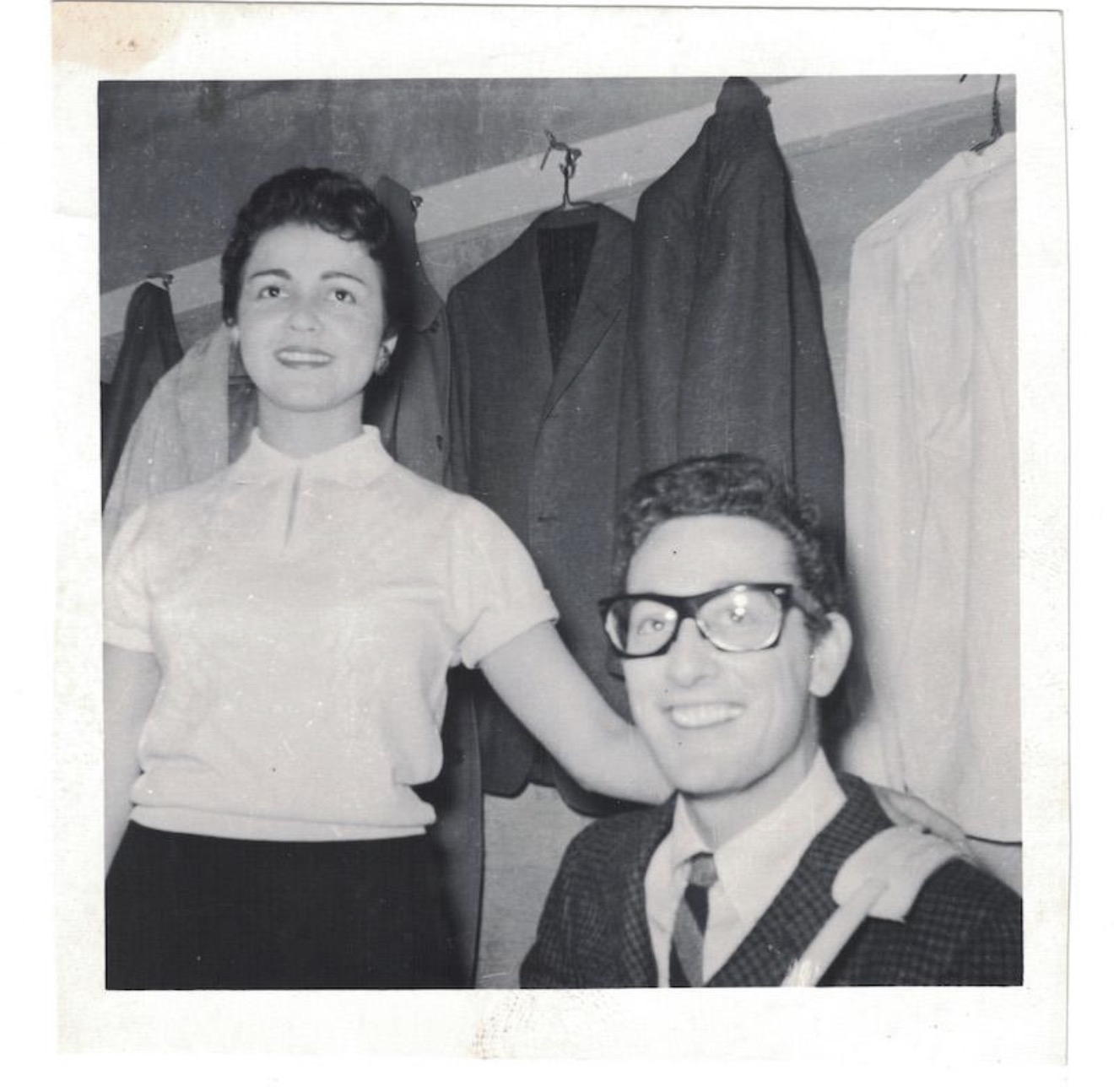
Buddy Holly was only 22 years old, but he had already achieved what many musicians dream of accomplishing throughout their entire lives. With his signature glasses, guitar, and distinctive voice, he had become one of the most important figures in American rock and roll. But while audiences listened to his songs on the radio, a much more difficult story was unfolding behind the scenes.See more…
On August 15, 1958, Buddy married Maria Elena Santiago, a woman he had met in New York. Their relationship had moved quickly and romantically. According to the story, during their first date, he invited her to dinner and proposed marriage. Within just a few weeks, they had become husband and wife.
After their wedding, the couple began their life together in Greenwich Village, Manhattan, in apartment 4H at the Brevoort Apartments, located at 11 Fifth Avenue. For Buddy, New York was more than just a place to live. It represented an opportunity to begin a new chapter, away from the people who had controlled much of his career until then.
He had much bigger plans than simply continuing to record hit songs. He wanted to establish his own music publishing company, produce younger artists, and gain greater control over his songs and earnings. One of the young musicians he hoped to help was Waylon Jennings, who would later become a country music legend.
But a major financial conflict was waiting for him. For years, producer and manager Norman Petty had been a central figure in Holly’s career. He had produced many of Holly’s recordings at his famous studio in Clovis, New Mexico. However, the way earnings and songwriting credits were divided had begun creating serious tensions.
One of the most controversial issues involved Petty being listed as a co-writer on several of Holly’s songs. Some musicians and researchers have questioned the extent of his contribution to those compositions. In the music industry of that era, songwriting credits could generate substantial income for many years.
Over time, Buddy began questioning whether he was receiving his fair share of the money generated by his recordings. Problems involving financial accounts and payments became one of the main reasons his relationship with Petty fell apart. This was not simply an argument between two men; it was a dispute that threatened the financial future of a very young artist.
When Buddy decided to leave the old arrangement, his relationship with The Crickets changed forever. Joe B. Mauldin and Jerry Allison chose to remain in Clovis and continue working with Norman Petty. Holly now had to continue his career without two of his most important collaborators.
The separation was especially painful because Buddy was not simply leaving a producer behind. He was leaving a team that had helped create the sound that made him famous. The Crickets continued without him, while he had to build a new path as a solo artist.
In New York, he began experimenting with a quieter and more personal sound. Instead of relying entirely on large recording studios, Buddy used an Ampex tape recorder in his apartment. There, he could record new ideas, experiment with melodies, and work without the pressure of a traditional recording studio.
These recordings are now known as The Apartment Tapes. Among them was an acoustic version of Peggy Sue Got Married, a follow-up to his famous hit Peggy Sue. It offered a different perspective on the song’s character, with a more intimate and gentle atmosphere.
On December 3, 1958, he recorded apartment versions of songs including That’s What They Say and What to Do. In the days that followed, he also worked on That Makes It Tough, Crying, Waiting, Hoping, and Learning the Game. These recordings would become incredibly important after his death.
What many fans do not realize is that these songs were not originally intended to be a completed album. They were personal demos and working recordings that Buddy could develop further in a professional studio. After his death, some were overdubbed with additional instruments and vocals before being commercially released.
Meanwhile, his personal life was changing. Maria Elena was pregnant with their first child. Buddy now had even more reasons to think about the future: rent, family expenses, medical bills, and his desire to provide his wife with a secure life.
But his financial problems remained unresolved. Because of the dispute with Petty and uncertainty surrounding his earnings, Buddy needed immediate money. Rather than staying in New York and waiting for the dispute to be settled, he accepted another demanding touring opportunity in the Midwest.
In January 1959, the Winter Dance Party tour began. It was an exhausting schedule of 24 cities in 24 days. Holly’s new touring band included Waylon Jennings on bass, Tommy Allsup on guitar, and Carl Bunch on drums. Because of the demanding schedule, the musicians had to travel almost constantly from one city to another.
Many of their journeys took place aboard old buses in freezing temperatures. The heating systems often failed, and traveling along the icy roads of the Midwest was exhausting. The musicians had to endure fatigue, bitter cold, and demanding schedules while audiences continued waiting for their performances.
Buddy wanted Maria Elena to remain in New York during the tour. She was pregnant and had been feeling unwell. So, instead of having her beside him as she had been on previous trips, he left without her. It was a decision that would take on an even more heartbreaking meaning after the events that followed.
Another important detail was that Paul Anka had specifically written the song It Doesn’t Matter Anymore for Holly. The song was released in late 1958, with Raining in My Heart on the other side of the record. After Buddy’s death, Anka gave Maria Elena his share of the song’s royalties to help support her.
On February 2, 1959, Buddy performed at the Surf Ballroom in Clear Lake, Iowa. Exhausted by the constant traveling and difficult bus conditions, he decided to fly to Fargo, North Dakota, aboard a small airplane. Ritchie Valens and J.P. Richardson, better known as The Big Bopper, joined him on the flight. In the early hours of February 3, the plane crashed into a snow-covered field. There were no survivors. Buddy Holly was just 22 years old. Maria Elena had lost her husband, and the child they were expecting would never be born: she suffered a miscarriage following the news of the tragedy. This was the end of the life of an artist who still had so many plans, songs, and dreams ahead of him. But the recordings he left behind in his New York apartment remain a rare glimpse into the music he was preparing to create.
Leave a Reply